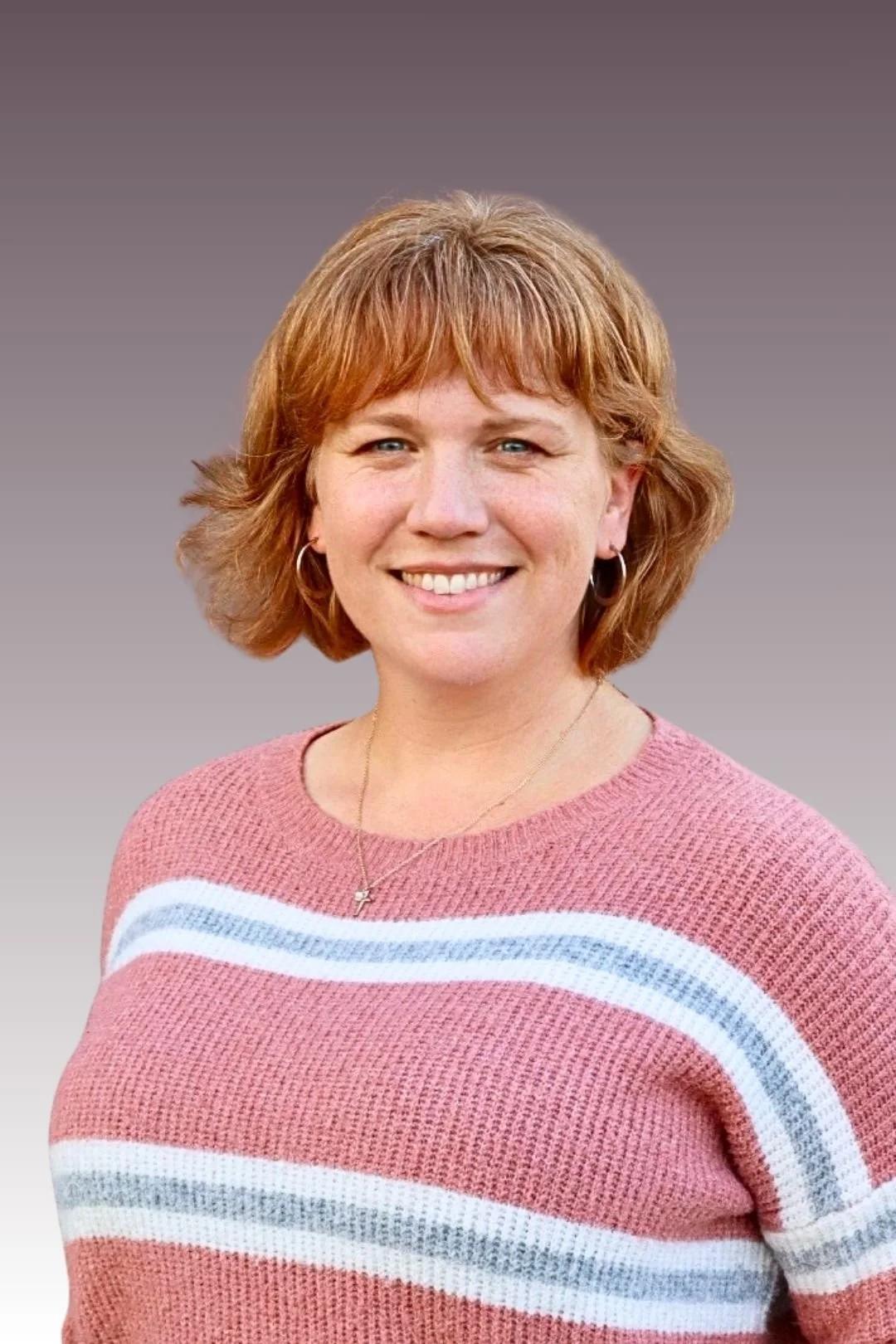
A week at the Strong Towns National Gathering left me with new tools, new friends, and a renewed sense of purpose for what we're building right here in our neighborhood.
I'll be honest. I wasn't entirely sure what to expect when I hopped in Eric Pruitt’s minivan at 7am on a Monday morning.
We were set to drive to Fayetteville, Arkansas to attend the Strong Towns National Gathering for several days. I've been in the weeds of local advocacy for a few years now — attending mobility committee meetings, speaking at city council, watching cars speed through my kids' school crossings — and sometimes that work can feel very lonely. Very local. Very small.
This gathering reminded me it is not small at all.
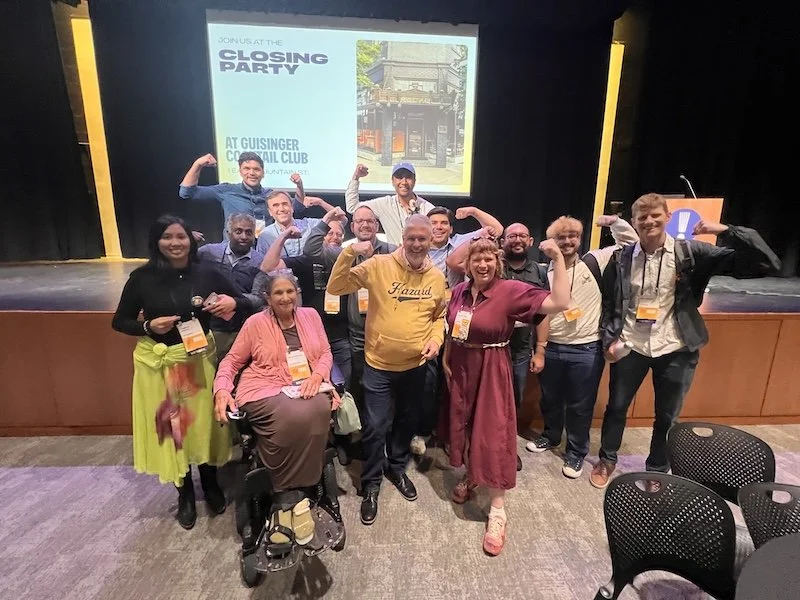
We met over a dozen Texans at the National Gathering and took this photo with Chuck Marohn.
A few hundred people from across the country converged to talk about something that is easy to dismiss until you look closely at it: the way we build our cities and neighborhoods is failing us, and we have more tools than we think to fix it. Over several days I attended sessions that cracked open new ways of thinking, had a conversation I will not forget with Chuck Marohn himself, and came home with a clear sense of what Stronger Denton needs to do next.
Here is what I want to share with you.
The Session That Changed How I Think: The Power and Responsibility of Place
The session I keep returning to was presented by UNT Alumni Ryan Short, co-founder of Civic Brand and author of The Civic Brand: The Power and Responsibility of Place. If you have not heard of Ryan, Chuck Marohn wrote the foreword to his book — which tells you something about how important this work is to the Strong Towns movement.
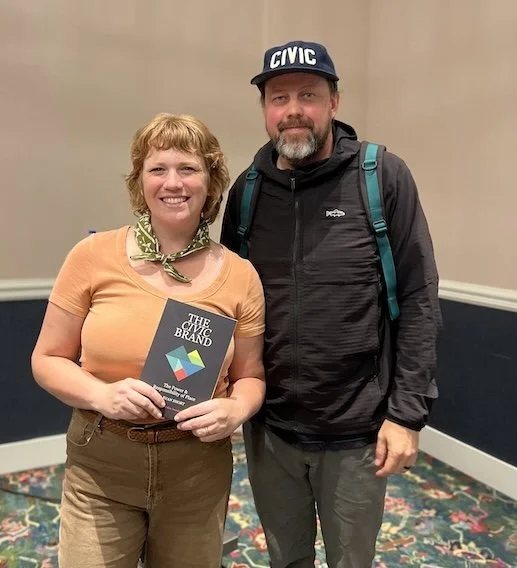
I had a chance to meet Ryan Short and snag a free copy of his book, The Civic Brand.
Ryan's core argument is deceptively simple: communities already know what they value. They have people who care deeply about walkability, safer streets, housing, local businesses, and the kind of neighborhood life we all want.
The problem is that those people are operating in silos — the transit advocate crashes into the housing advocate, the city department works parallel to the nonprofit — and without a shared language and a shared vision, all of that passion dissipates.
A civic brand, Ryan argues, is not a logo or a slogan. It is not a tourism campaign. It is the "North Star" — the shared identity and shared language that helps a community coordinate its efforts, make daily decisions with intention, and resist the mimicry that turns every Texas town into the same strip mall lined corridor.
What struck me most was his insistence that you have to go deeper than the generic to find what is actually true about your community. Not what just sounds good or could be printed on a t-shirt.
I came out of that session with a notebook full of scribbles and a question I want to bring to our community: What is uniquely, authentically true about my neighborhood? And what would it look like to build a brand around that — not to market it, but to guide us?
I believe a neighborhood-centric identity and revitalization campaign is exactly what our corner of Denton needs. Stay tuned. This is the seed of something.
A Conversation With Chuck Marohn
I am still a little giddy about this one.
Chuck Marohn is the founder of Strong Towns. He wrote Strong Towns: A Bottom-Up Revolution to Rebuild American Prosperity. He has spent decades making the case that the way American cities have been building — the big roads, the separated land uses, the car-first design — is not only harmful to people but is also bankrupting municipalities. His ideas have shaped everything I believe about urbanism.
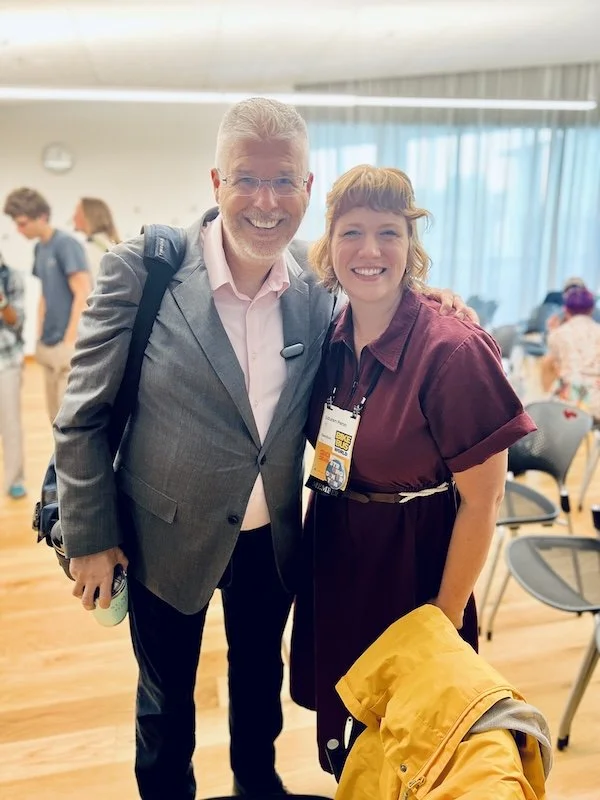
I got to speak with him personally, and I told him what I tell everyone who asks why I do this work: my kids want to walk to school, and the streets around our neighborhood are not safe for them.
He listened. He understood. And that moment of being heard by someone whose work you admire — it refuels you in a way that is hard to describe.
The conversation reinforced something I already believed: this is not abstract policy work. Every data point in the Strong Towns framework represents a kid who should be able to walk to their school, a neighbor who should be able to cross the street without fear, a community that deserves better than what sprawl has given us. That is why Stronger Denton exists and why I continue to work alongside my neighbors.
San Antonio Is Not Waiting: The Case for Quick Builds
One of the most practically useful sessions of the whole gathering was led by Dr. Sukh Kaur, the District 1 Council Member from San Antonio.
Dr. Kaur represents a district that is as complex as any in the state — downtown, historic neighborhoods, some of the sharpest contrasts between wealth and poverty in the entire country. She came to this work as a former Teach for America educator who ran for council because she believed too many kids were showing up to school having nearly been hit by cars. Sound familiar?
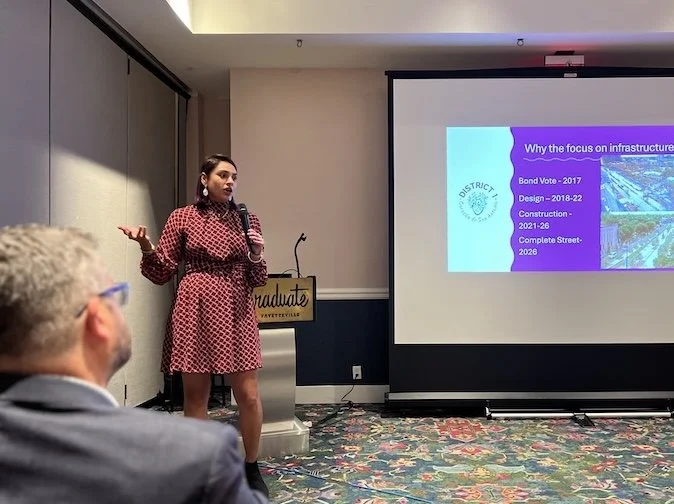
Her session was a candid look at what it actually takes to move quick build projects through a city government — and what gets in the way. San Antonio has a gold-medal Complete Streets policy.
It has a Vision Zero plan. It has an updated Bike Network Plan. On paper, it is a model city. In practice, a single stretch of bike lane recently cost $500,000 because of expensive precast curbs, and major street projects routinely take five to eight years to complete — not unlike here in Denton.
But here is where it gets hopeful.
A neighborhood organization in District 1 secured an AARP grant and used it to build a bulb-out crosswalk project— a curb extension that slows traffic and makes pedestrians more visible to drivers. Even with the grant in hand, the city required a traffic engineering review and the project took eight months. But it happened. And it works.
Dr. Kaur's office has also been using painted interventions in areas that need attention — lower-cost, faster-to-implement treatments that create real change without waiting for a decade-long capital improvement cycle.
The lesson she drove home is that community groups can move faster than city government when they bring grants, build relationships with department heads, and learn the specific language the city uses so that "bollards" doesn't get interpreted as $10,000 retractable steel cylinders instead of $30 flexi-posts.
The parallel to Denton is almost uncomfortably direct. Our city projects take the same five to eight years. We have the same advocacy energy and the same bureaucratic friction. What San Antonio is learning — slowly, imperfectly, but genuinely — is that quick builds are not a shortcut around good design. They are a way to test, demonstrate, and prove change before it gets locked into concrete.
That is a model worth studying. And it is work I want to bring back to our streets.
What This Means for Stronger Denton
I came home from the National Gathering more energized than I have been in a long time, and also clearer about the next steps I want to take.
The Strong Towns National Gathering reminded me that we are not alone. There are people in San Antonio and Bloomington and Lubbock and Salida doing this same work — figuring out the specific, true thing about their place, and building from that. Denton has its own story. Our neighborhoods have their own stories.
Let's write them together.