How Antiquated Parking Rules Are Squashing the Denton You Love—and Building the Denton You Fear
Imagine trying to open a tiny restaurant in an old Denton building.
The kitchen fits.
The dining room fits.
The rent barely works.
You decide how many tables the business can support, how much equipment they need, how many employees to schedule, and how much space to devote to storage.
Then comes the question:
Does the parking fit?
Not according to how much you need for your customers so you can succeed. According to an arbitrary table in Denton’s development code.
That table determines how many spaces the restaurant must provide based on its size. If the property isn’t big enough to satisfy the parking formula, you will not be allowed to open your restaurant.—It doesn’t matter how well the kitchen works, how many tables the business can support, or whether customers actually need that much parking.
For a small business owner, “just add parking” may mean buying land they cannot afford, demolishing part of the building, tearing out trees, or walking away from the location and their dream.
A huge out-of-town chain has the deep pockets to buy extra land, build a massive parking lot, and absorb the cost. A local owner opening a six-table restaurant usually does not.
That matters because all buildings adapt over time. A house becomes an office. A shop becomes a restaurant. A warehouse becomes a brewery. One business closes, and someone with a completely different idea moves in.
That flexibility is what gives us more unique local businesses.
Some of the places that make Denton feel like Denton could not be built the same way today.
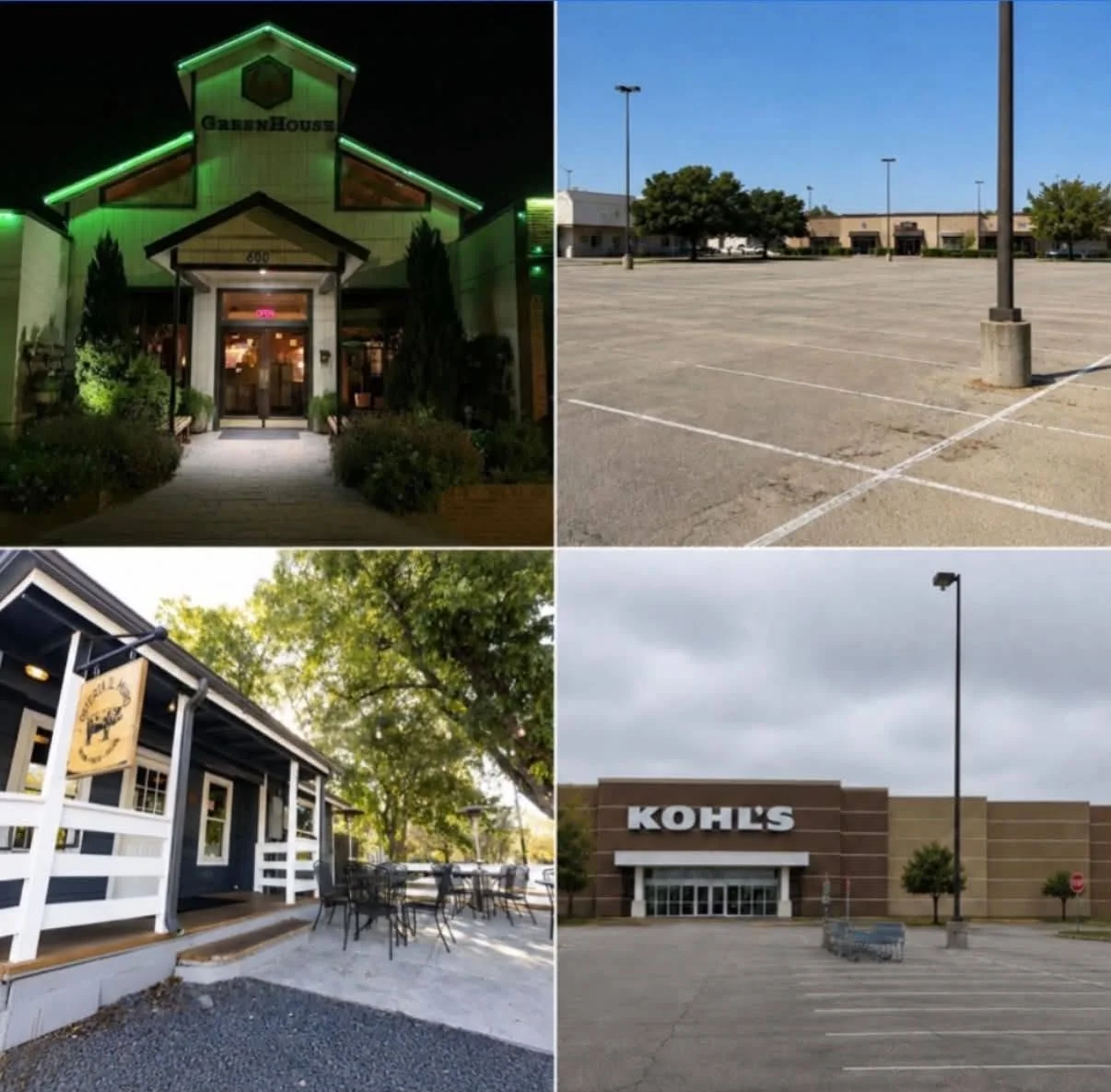
Think about Osteria il Muro: a tiny restaurant tucked into an older building near downtown, with a scale and setting that feel entirely Denton—and completely different from a chain restaurant surrounded by a giant, hot parking lot.
Or Aglio Pizza, which operates inside the Yoga Project space. During the day, people come for yoga. Later, the same building becomes a pizza restaurant. Same walls. Same parking spaces. Different customers at different times.

This multi-purpose building hosts Yoga Project studio by day, Aglio Pizzeria by night.
GreenHouse, Mr. Chopsticks, Loco Cafe, Frosty’s, and the beloved businesses that once filled 424 Bryan—Art Six, Killers Tacos, El Cucuy Burritos, and The Saucy Hibachi—are part of that story.
These businesses adapted old buildings, shared spaces, worked within limited footprints, and figured out how many tables, chairs, counters, and parking spaces made sense for their particular businesses.
We don’t tell Ace Hardware how many cash registers it must have. We don’t mandate how many barber chairs a barbershop needs, how many ovens a bakery must install, or how much empty floor space a store must keep available for its busiest possible day.
We let the business decide.
So why do we treat parking differently?
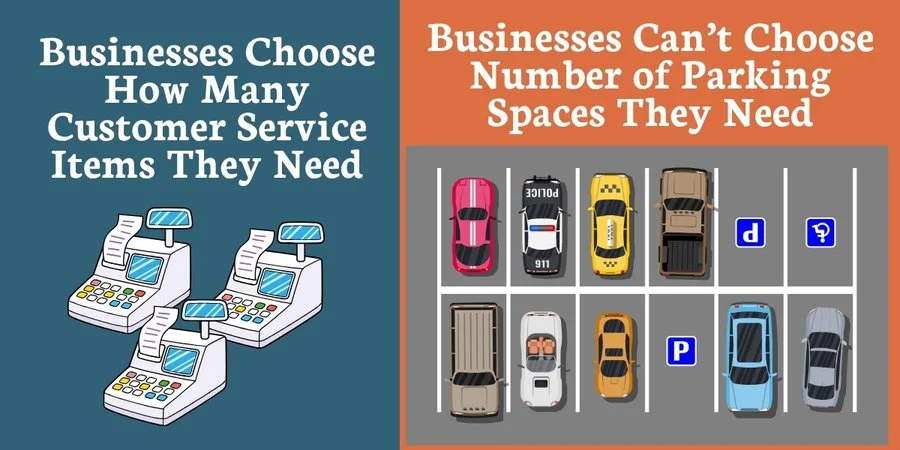
Denton business owners make decisions on how to best service their customers.
Parking mandates quietly squash the adaptability that helps small businesses get started. They push new development toward huge strip malls with giant parking lots, while older buildings sit empty and unable to be leased because they cannot satisfy the minimum parking requirements.
That raises a question:
Are parking mandates making it harder to create new spaces that keep the Denton feeling we love?
There’s a strange thing about parking: when we require more of it, it feels free.
But it isn’t.
Someone pays for every parking space in Denton. The cost may show up in housing prices, storefront rents, dinner prices, or in the businesses that never open because the numbers no longer work.
Structured parking can cost tens of thousands of dollars per space. Those costs do not disappear. They become part of somebody’s rent.
That means an artist struggling to afford an apartment may help pay for someone else’s parking whether they own two cars, one car, or no car at all.
The people least able to absorb another $50, $100, or $200 in monthly housing costs are often the people most affected by that hidden bill.
Parking mandates also have environmental costs.
Every additional space means more pavement absorbing summer heat and producing stormwater runoff filled with tire debris and oil. It means less room for trees, buildings, patios, and people. When every destination must be surrounded by more than enough parking for its busiest possible moment of the year, everything spreads farther apart, creating more traffic, dirtier air, and a less sustainable city.
That makes walking and biking harder. It makes good transit harder, too.
If we want better public transportation, we need homes, jobs, restaurants, and other destinations close enough together for frequent service to thrive. Spreading destinations apart to make room for excess parking works in the opposite direction.
None of this means Denton should eliminate parking.
Businesses will still provide parking when customers, residents, lenders, and local market conditions support it. In Buffalo, after minimum parking requirements were eliminated, developers continued to build parking—but generally provided fewer spaces than the old mandates required. Research from Seattle, Minneapolis, and parts of California shows similar patterns: some projects provide nearly as much parking as before, while others provide less, especially near transit or where parking is expensive and less necessary. More than 120 cities have removed minimum parking requirements.
Removing a mandate does not ban parking.
It lets the people who own, finance, and use a property decide how much parking makes sense instead of imposing an arbitrary one-size-fits-all number.
That distinction matters.
The choice isn’t: Parking lots or no parking lots.
The choice is: Who decides how much parking a property needs?
Should it be the business owner whose customers will determine whether the business survives? The apartment developer whose units will not rent if residents have nowhere to park? Or City Hall, using an arbitarary formula written into the development code?
Denton already recognizes that these formulas do not always make sense. Downtown has exceptions. Infill projects can receive permission to build less parking than normally required. The code makes allowances for transit, affordable housing, bicycle parking, and other circumstances.
Allowing less parking is not a radical idea. It is a question of how much flexibility we want to give the people trying to build the next beloved thing in Denton.
When I look around Denton, much of what I love is not the newest building with the biggest parking lot.
It is the old house that became a restaurant.
The storefront that became something nobody originally planned for.
The slightly weird building where several businesses figured out how to make it work.
The small place surrounded by trees instead of asphalt.
We should make sure our rules leave room for those places too.
Because a city can lose its character very slowly.
Sometimes one required parking space at a time.