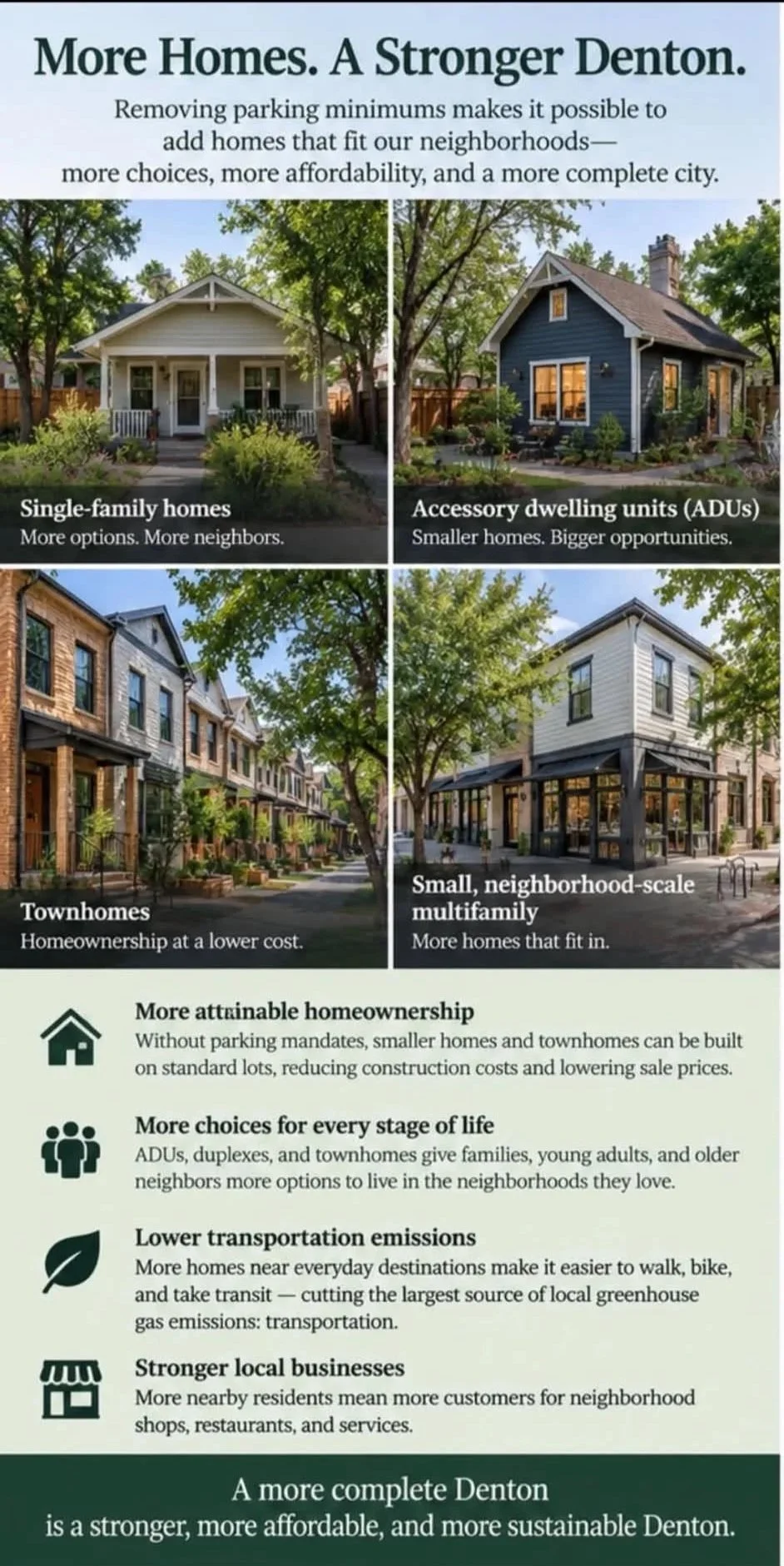
I hear the same concern pretty often in Denton: Why does every new housing project have to be another enormous apartment complex along a major road?
It doesn’t.
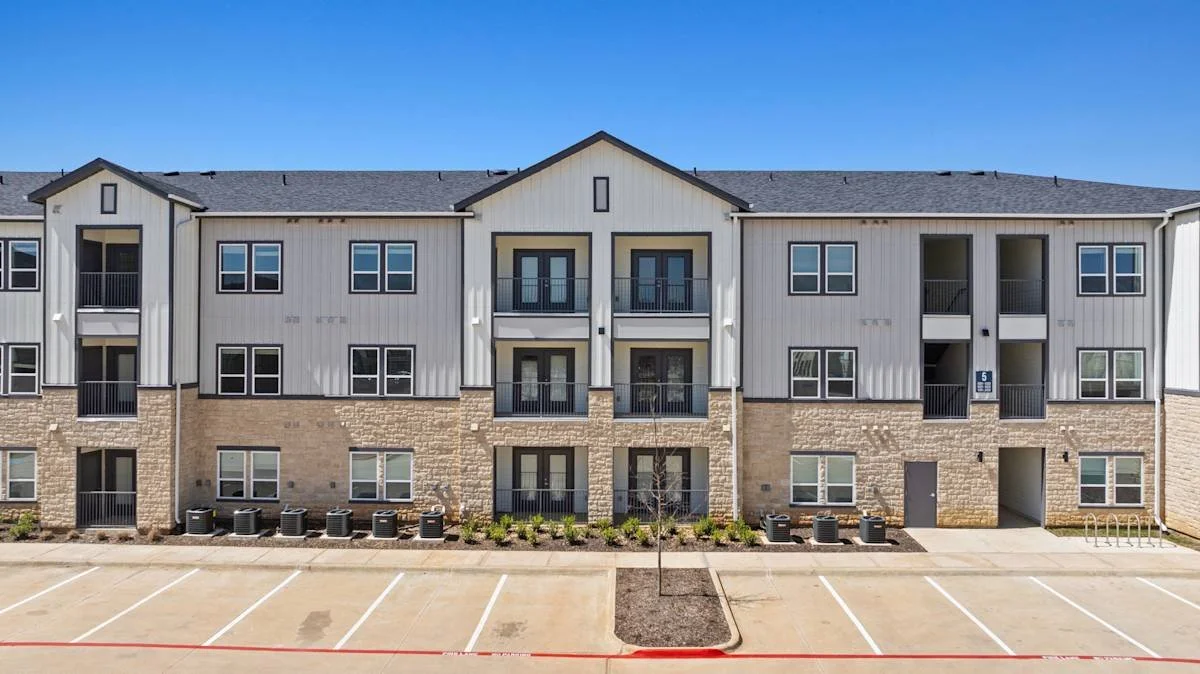
There is a whole category of housing between a detached house on a big lot and a 300-unit apartment complex. Duplexes. Cottage courts. Townhomes. Small condos. A few detached homes sharing a common drive. An ADU behind an existing house.
These are the kinds of homes that add housing a little at a time, inside neighborhoods that already exist. They can also create something Denton really needs: smaller homes people can actually own.
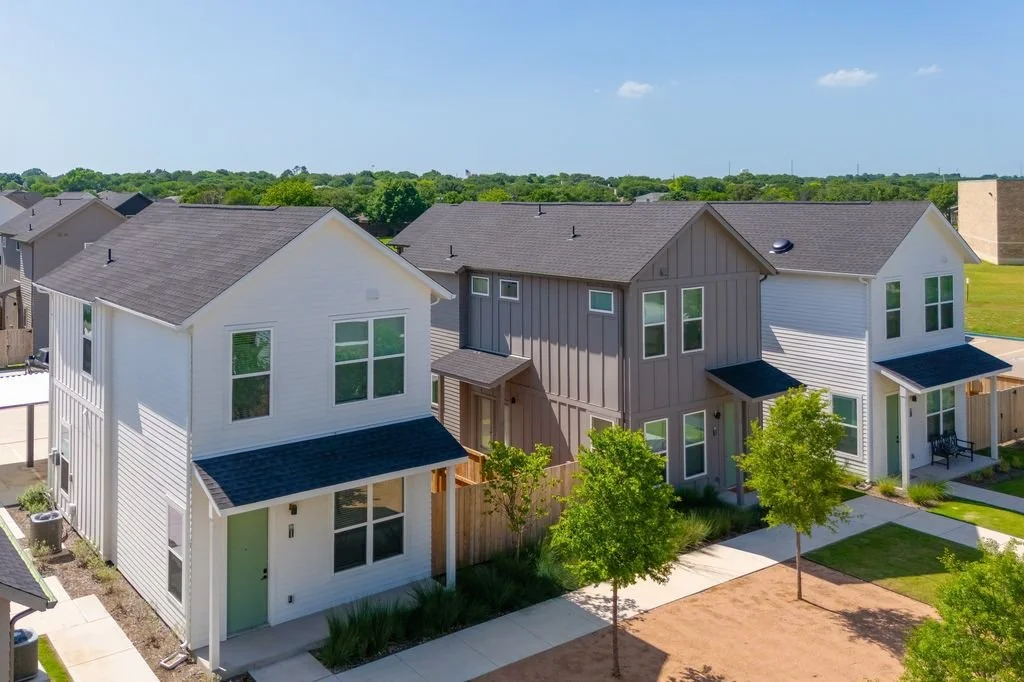
Only about half of Denton households own the home they live in. The Census now puts the median value of an owner-occupied home here at about $348,000, while the City’s housing analysis identifies housing cost burden as our most common housing problem, affecting more than 24,000 low- and moderate-income households. Home sizes over the past 75 years have more than doubled in size, while family sizes have shrunk by over 30%. We need more smaller homes. Current regulations combined with the economic reality that homes are built to create as much money as possible in the form of large mortgages means we don’t get the smaller homes we need. We need to change many things to flip that script, but the first is parking mandates.
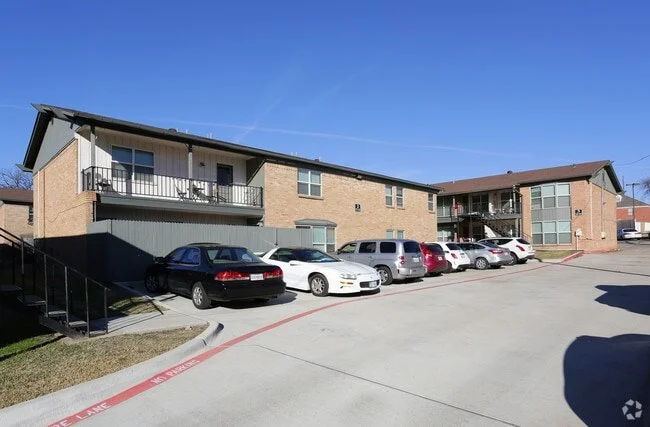
Parking rules seem like an odd place to look for part of the solution, but they matter enormously on small lots.
A parking stall is about 180 square feet. Once you include the aisle needed to reach it, planners commonly use roughly 350 square feet of land per parking space. And in a neighborhood when you include a driveway, that number can balloon to 800-1000 square feet per parking space. On a big apartment site, these costs can be spread across hundreds of people. On a small lot where someone is trying to build three townhomes or a cottage court without cutting down trees, several mandatory parking spaces can kill a project which would otherwise build a few modest-sized homes we need.
This is not theoretical. Portland removed off-street parking requirements while making duplexes, triplexes, fourplexes and cottage clusters easier to build. Portland now reports that its reforms have produced more than 1,400 ADUs and middle-housing units and created more opportunities for individually owned, smaller homes in existing neighborhoods. (Sightline Institute)
That does not mean nobody builds parking. A buyer with two cars is likely to want it. A builder trying to sell that home has every reason to provide it when the market calls for it.
It means city parking rules no longer decide whether the home itself is legal.
There is another reason this matters.
When we make small-scale housing difficult inside existing neighborhoods, growth does not disappear. We get more large projects where zoning allows them, and more subdivisions farther from the center of town. Both outcomes put more people farther from the places they go every day.
Transportation is now the largest direct source of U.S. greenhouse-gas emissions. The EPA specifically recommends walkable, bikeable and transit-supportive development as one way cities can reduce those emissions. (US EPA)
That doesn’t require turning every neighborhood into downtown.
It can mean a few more neighbors. Enough people nearby to support a coffee shop, small grocery, daycare or restaurant. Enough riders to make better bus service worthwhile. Enough homes that a teacher, young family, retiree or first-time buyer has something to choose besides a large apartment or an expensive detached house.
If we really want growth that fits Denton better, we have to make the smaller alternative possible.
Removing parking minimums is one surprisingly important piece of that.
The city’s Development Code Review Committee will start talking about this missing middle housing on Monday, Sept. 14.
On Sept. 15, Council decides whether to run a 1-year pilot of removing minimums, or continue the status quo which increases traffic by concentrating new housing in large apartment complexes and far-flung subdivisions.
This week will go down in Denton history: what kinds of housing do we want? Make your voice known today.